
The People's Santa
The Eternal Father Christmas
Most of us have a knowledge of the fat elf-like cartoon character known as Santa Claus. Since early youth images of this red costumed overstuffed creation have been bombarded upon us to the point that we accept this character as a force of nature. It is always there and if given the correct circumstances the red Santa will reward us with stuff at the end of the year.
From late October until the first of the year our bulbous elf is everywhere, on TV, on the phone, on product labels, on email, on websites, on popups, on cardboard cutouts, on the side of buses, on soft drinks, on booze ads, on clothing. It is an endless loop of sophisticated conditioning aimed at us since childhood. It is neither inherited or religious yet it is omnipresent as if it was a god of some sort. But where did it come from?
Santa of the Battlefield
In the 1840’s Thomas Nast arrived with his parents in America as an immigrant from Europe. He and his family lived in New York City and he would eventually attend the National Academy of Art and then land a job as an illustrator for various popular periodicals. By the 1860’s he became a political cartoonist for Harper’s Weekly, a rabid anti-Southern tabloid that was fashionable with supporters of the Federal cause.
Mr. Nast became famous by vilifying Southern people with his cartoons often characterizing soldiers as animals or sadistic demons. Extreme polemics became his trademark in both his war drawings and political images that were decidedly pro-administration and anti-Southern making his work at Harper’s Weekly very successful. For him the War created easy outlets to vent the political bias of the publishing class in New York this lead to a rise in his stature. Political views with an eye on popular acceptance was the key to his commercial success.
As the War was winding down Nast began dabbling in less sharp edged images. The public’s taste began to change and his ratings fell but his fertile pen came to his rescue and began creating characters to delight the public one of which was the corpulent gift giving gnome who inhabited the commercial Christmas season. Thomas Nast played a foundational role in shaping the modern image of Santa Claus who was not a religious figure but would fill the role of a supernatural being that could heal people with gift giving after a war that had so grievously damaged the national psyche.
This was the real beginnings of the modern Santa Claus. Although there were precursors none fit the bill of a secular god-like apparition that had the ability to endlessly produce goodies.
The Revenge of Rome by Jove
The new commercial entity was the perfect incarnation of the Roman god Jupiter who bestowed material wealth and good times and had not one thing to do with the coming of a transcendent spirit and all the serious religious baggage that accompanied the birth of Lord Christ. He is the bringer of abundance in both mythology and cartomancy. This king of the gods often called Jove, is associated with the protection of government power while his influence brings luck, generosity, and money. This was just the kind of atheist spirit the United States needed after the grim years of war. No more scarcity, anger, fear, or death what we needed was a great sugar daddy who brought wealth to the northern states while looting the South. Never mind that, the new Santa was a political cartoon not a saint.
This Santa of universal payouts became more and more popular epitomizing the rise of power the United States was experience in the post-war years. He was the avatar, a bloated gift bestowing elf and an emblem of plenty, a literal cornucopia of material goods to satisfy the thirst of a new world power.
Generally depicted in the well known bright red and white costume the jolly old rascal attracted the attention of Coca-Cola company executives whose familiar flagship product used the same color scheme. Although Coca-Cola did not create the story of Santa Claus, the company played a important role in shaping the modern image of the character. Large gatherings of people needed a distinctive drink to share at parties and merrymaking: a special leisure time beverage to make the occasion memorable. Big Red Santa Claus had bags bulging with loot heralding the time of plenty not unlike the Roman god Jupiter blessing state power. What better symbol to completely wipe away the image of a traditional Christmas than an orgy of materialism.
But It Wasn’t Always That Way
The architects of our past have gone to some trouble tweaking and flexing this fact and that event to build a past that justifies the present. In George Orwell’s book 1984 the main characters were employed doing just that to ensure that today’s invented headlines lined up with a fictional past so the dictates of the rulers comported with a accurate but artificial timeline. Important cultural characters must be given protection so their history is documented in a favorable way. Is good ole Santa immune to this type of manipulation? Unlikely.
Notwithstanding the fact that there have been any number of individuals identified with festivals that occurred at about the time of the Winter Solstice in the Northern Hemisphere few fit the identity of the modern American Santa. He is the creation of a post-Civil War zeitgeist liberally mixed with 20th century commercialism. Yet despite being somewhat hidden there are some pathways into the thicket of the past that give us insight into a more humane spirit that comes from traditions emerging out of the deep collective memory of our unconscious mind.
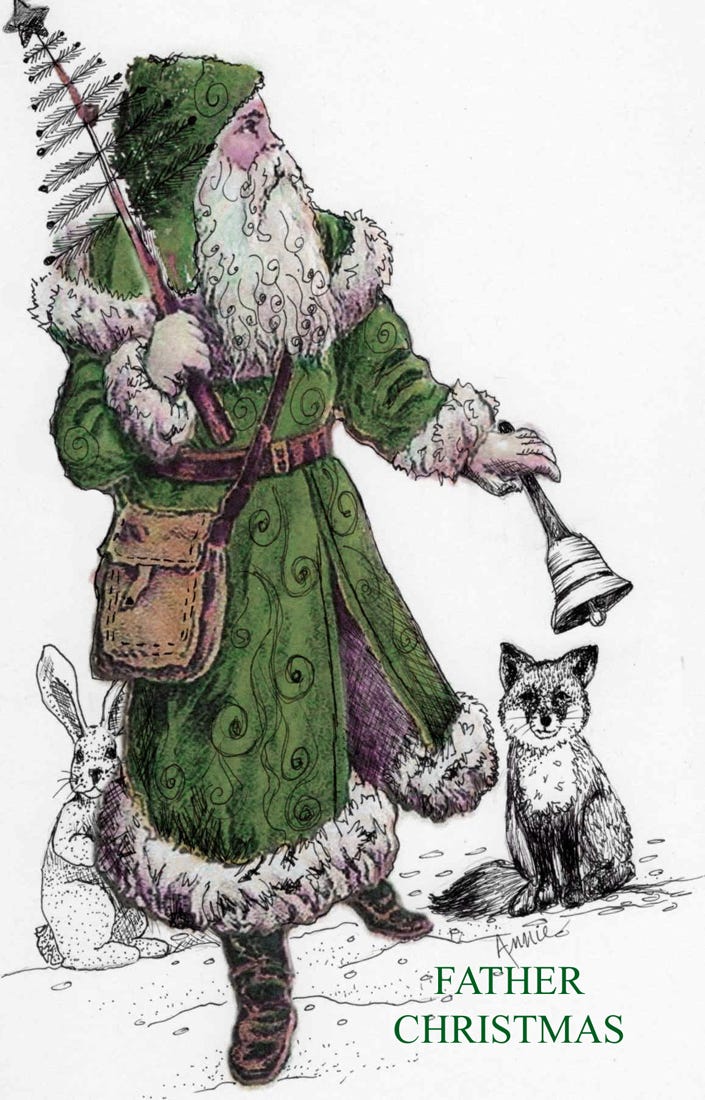
For many years my wife Annie and I have made Christmas cards which we send out in lieu of store bought cards. In researching designs for this year’s issue I came across some 100 year old examples of Santa. All of them were the familiar red draped elf in various poses except a very few in a collection that had some unusual designs labeled with country or era they represented, except one of a green cloaked santa with few identifiers and no attributions. It appeared to be late Victorian or fin-de-siecle European, perhaps Eastern European.
With a little extra research I compared it to other graphics and description and determined that it was likely a hybrid that incorporated several ideas and styles into this example. I thought it to be strangely compelling carrying a interesting emotional impact that modern drawings do not have. Mind you it is not the image it is the spirit behind it that is important.
This was no ordinary production Santa but a representation of a spirit. I digitally lifted the image and placed it in a neutral background. We consulted on where to go with it and tried to maintain the integrity of the original while incorporating some appropriate symbolic references: this was Father Christmas.
The ancient spirit was not designed as a part of a national manifest destiny or the advertising in a shop window. He was the messenger ringing the bell of “good news” that Winter will soon be declining and that the Angel of Light had been born guiding us out of the spiritual winter of despair and uncertainty. According to tradition he went from house to house bringing gifts, that were not knickknacks or цацка (tsatska*), but the gift of good news and health in the coming year often facilitating a cure for chronic illness that have afflicted the household.
Without a doubt this is the same spirit from old English and Irish folk tales that circulated before mass marketing. Being cousins to the Continental Celts who likely influenced this thinking and very early on incorporated them into the lore of mystical beliefs that grew up in the countryside fusing Christian stories into the mix and arriving at a universal People’s Santa. Not directly copied from a book or legend and not devised from a product marketing campaign this was a grassroots Santa of the people who created a symbol of faith, belief and hope.
Using ancient stories and fables as a guide I encouraged Annie to give our Santa some shamanistic attributes. The green robe was adorned with designs of mystery and the satchel evolved from cloth to more durable leather, they were both kept but the tree and star across his shoulder were added remembering that boughs of evergreens where given to remind people of eternal renewal. This pine bough sported the all important star that is our spiritual guide and we added the rabbit and fox. The bunny is a symbol of fecundity and health while the keen senses of the fox protected and warned Father Christmas of dangers in the wilderness. In the presence of this green spirit the two animals could coexist without fear or greed united in their love for and dedication to Father Christmas.
Our Father Christmas tied together spiritual traditions and created an amalgam of symbolic energy that is deeper and more fulfilling than any blow-up Santa Claus in a parade. He comes to us from the timeless land of symbol and myth untarnished by website ads or beverage cans. He is Father Christmas the spirit of good news and sharing and good will to all people.
*”chachkies” and “tchotchke” refer to the same concept: small, often inexpensive trinkets or souvenirs
More than ever Please leave a contribution for the author my situation is not good. 👇 (This is a very secure site and the people who operate this Tip Jar are helpful and receive only a small fee for their service)
Leave the ROAD AHEAD a gift through ko-fi.com


*See more in the Gallery
You have created a symbol of hope and endurance in this narrative. Intrinsic in this is also that of resurrection, of faith and continuance. Thank you.